

Is South Africa teetering on the edge of becoming a mafia state? Read an extract from Mafia Land by Kyle Cowan
More about the book!
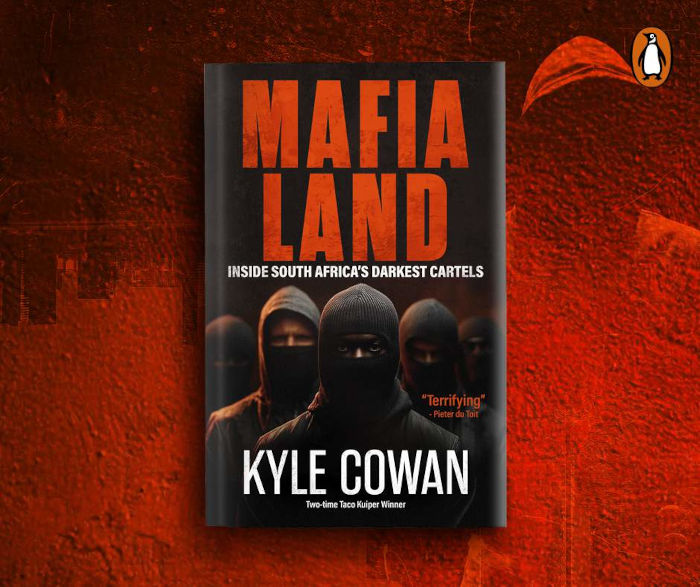
Penguin Random House SA has shared an excerpt from Mafia Land: Inside South Africa’s Darkest Cartels, in which multi-award-winning journalist Kyle Cowan rips open the terrifying truth about organised crime.
Beneath South Africa’s surface lies a brutal world of mafias and cartels vying for the nation’s wealth – the tobacco, taxi, water, hospital, construction and police mafias all exploit a system of corruption reaching from streets to government.
Patronage networks entangle municipalities, state enterprises, political parties and law enforcement, silencing those who resist.
In Mafia Land, Cowan exposes 12 of the country’s deadliest cartels, revealing a chilling reality where organised crime and the state are so intertwined it’s nearly impossible to tell where one ends and the other begins – a nation teetering on the edge of becoming a mafia state.
Read an excerpt:
~~~
PROLOGUE
While finalising this manuscript and preparing it for production, the country was rocked by breaking news that, for a moment, made even the most cynical South Africans sit up and take notice.
On 6 July 2025, Lieutenant General Nhlanhla Mkhwanazi, KwaZulu-Natal’s top cop and a career policeman of over 30 years, stood behind a podium and did something that defied convention, protocol, and political loyalty: he accused the Minister of Police, Senzo Mchunu, of actively undermining the South African Police Service by colluding with organised crime syndicates. Not in hushed tones behind closed doors, not through a veiled press statement, but publicly, live on national television.
He alleged that Mchunu had shut down the Political Killings Task Team (PTKK) in KwaZulu- Natal – a unit responsible for solving some of the most high-profile politically linked assassinations in recent history – because it had begun to uncover a network of corruption in Gauteng that reached deep into the police, judiciary, and political elite.
At the heart of it all, Mkhwanazi claimed, were drugs, dirty money, murder, and the sabotage of law enforcement by those appointed to uphold it. According to his version, and as we explore in more detail later on, Mchunu’s allies were working hand-in-glove with Vusimusi ‘Cat’ Matlala, one of the co-accused in an ongoing murder trial and tenderpreneur, with the help of political fixer Brown Mogotsi.
Within days, President Cyril Ramaphosa placed Mchunu on special leave and announced a Commission of Inquiry, chaired by former Acting Deputy Chief Justice Mbuyiseli Madlanga, to probe the allegations and the systemic rot in the SAPS. Professor Firoz Cachalia, who headed up Ramaphosa’s Anti-Corruption Commission, was appointed acting minister.
The political fallout has only begun, but already it has become clear that Mkhwanazi’s bombshell was not a sudden revelation; it was the latest eruption in a long-dormant volcano of police corruption that has been rumbling since the dawn of democracy.
For South Africans, this was not just another scandal. This was a confirmation of something they have long suspected: that the SAPS is not merely infiltrated by organised crime – it is, in some respects, part of it.
From the moment the SAPS was restructured in the wake of apartheid, it carried the hope of transformation. But the promises of professionalism, accountability, and service to the people began to fade almost as quickly as they were made.
Just before the release of this book, the FW De Klerk Foundation published a damning report titled ‘Integrity and Oversight in South Africa’s Law Enforcement: 1994–2025’.
According to this report, no National Director of Public Prosecutions has completed a full term and nearly every SAPS National Commissioner has left office under a cloud of controversy.
Since 1994, the police service has been dragged steadily downward by a corrosive mixture of political interference, greed, incompetence and impunity. It has been a slow and painful descent, and now, suddenly, it seems like law enforcement is in freefall.
In 1999, just five years after the advent of democracy and with the wave of organised crime starting to swell, South Africa responded with a new law: The Prevention of Organised Crime Act. Looking back, the lawmakers had a remarkable level of foresight. They knew that South Africa could easily become a haven for syndicates, cartels, crime networks and mafia-style groupings.
The new law, however, failed to curb the tsunami of organised crime that engulfed the country in the decades that followed – not because the law itself is deficient, but because it has not been wielded with any real fervour.
What is unfolding now is not a crisis of mismanagement. It is the near-complete collapse of the moral and structural integrity of law enforcement in South Africa.
Consider this: A sitting provincial police commissioner has accused his minister of conspiring with a dubious character from the underworld of organised crime.
Cellphone records and payments uncovered by investigators and journalists suggest that criminal syndicates are not only targeting police officers, but they are also directing them, sustaining them, and in some cases, appointing them. In recent months, senior SAPS officers have been arrested for fraud, corruption, and abuse of intelligence funds. Crime Intelligence itself – the very structure tasked with protecting the nation from internal threats – has become one of those threats.
These revelations form part of a pattern that stretches back decades.
In 2008, the ANC-led government killed off the Scorpions, an elite corruption-busting unit of the NPA that had achieved extraordinary success in bringing corrupt political elites to book. As soon as they started investigating Jacob Zuma, deputy president at the time, for corruption in the arms deal, however, the ANC quickly intervened and disbanded the unit.
In 2010, the country watched as Jackie Selebi, then National Police Commissioner and former head of Interpol, was convicted of corruption for accepting bribes from Glenn Agliotti, a drug trafficker and murder suspect. (Agliotti was later acquitted of murder.) Selebi’s fall marked a historic low, but it did not stop the rot.
After Selebi came Richard Mdluli, the former head of Crime Intelligence, who abused his position to wage personal vendettas, misappropriate secret funds, and shield political allies. He too was eventually jailed – but not before deeply damaging the integrity of SAPS intelligence structures. Bheki Cele, later appointed Minister of Police, was himself dismissed as National Commissioner for dishonesty and unlawful lease deals – yet returned to helm the ministry in 2018.
~~~
Extracted from Mafia Land by Kyle Cowan, out now from Penguin Random House SA!
Categories Non-fiction South Africa South African Current Affairs
Tags Book excerpts Book extracts Kyle Cowan Mafia Land Penguin Random House SA
1 Votes
